The Story of SCALE

SCALE was the third chapter of the Savor Each Stitch Book Bee. Carolyn Friedlander’s book has a photo of bales of hay in front of a house and tree.

The caption reads, “Scale is relative to everything around it.”

On June 2, 2015, I wrote this in the book bee community:

I don’ t have a design in mind for Scale. I pulled some prints — large to small to inspire me. CF’s Circle Lattice is interesting and I like the idea of a large applique piece.


I had pulled some Kaffe prints and I sketched a large applique:

At the same time, my daughter was home for the summer from college and we visited the Virginia Museum of Fine Arts’ exhibit: Van Gogh, Manet and Matisse. The Art of the Flower. The exhibit was very crowded and the art was displayed in different rooms in chronological order, beginning with the early Impressionists. The early works were so real. The ladybugs on the leaves looked like they were alive right there on the paintings. Van Gogh’s work wasn’t lifelike but the paint was three dimensional . By the end I felt I had traveled through time, and I felt dizzy and overwhelmed by FLOWERS.

That experience stayed with me and I made a large applique flower (no photo). BUT, I didn’t like it.

I liked the Kaffe prints so I made a tote bag as a Scale warm-up.top stitch tote close

Since I liked the idea of a large flower, I created a large improvisational “flower” using solid scraps.
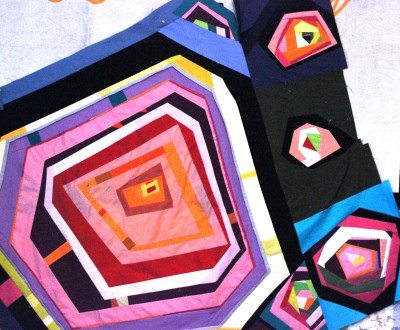
Scale piece


I didn’t like how the small flowers were interacting with the large one.

On July 16, 2015, I wrote:

 My Scale study has taken another turn. I decided to make some large and small improv “flowers.” I did that and tried to assemble them. Hated it, then slashed and reassembled them, and I think I’m getting somewhere. Now to decide if I need a border and how much border. I think it needs some “breathing space” — not sure what would be best.  Blue perhaps.
Scale pieces
Susan, a fellow bee mate, suggested BLACK, and I’m so glad I took her suggestion.
Don't say Beatlejuice, Nora Paige
After I putting on the face binding, I thought it needed some more hand quilting.
 Dotson.Wanda-Roses-FULL

That’s the story of SCALE.


Exploring Volume

Quilting makes the quilt, they say. When I began exploring the Volume chapter of Carolyn Friedlander’s Savor Each Stitch, I thought I had been thinking about volume all along. I had made five quilts, one for each of the chapters: Line, Contrast, Scale, Color and Emphasis (this one isn’t quilted yet).  I haven’t blogged about all of these — soon, I promise.

BUT, I learned I could use VOLUME to create a unique design.

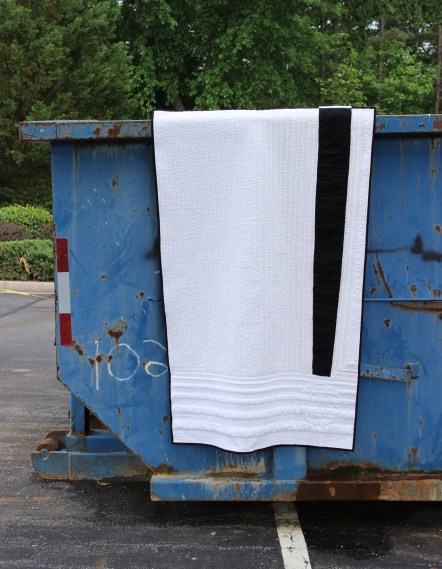
Solitude! full view2

Solitude!

Susan, a member of our Savor Each Stitch Bee, posted photos of ideas for playing with Volume. I began to think about trapunto. When I think of trapunto, I think of traditional quilts with feathers. Tim Latimer has a good tutorial on how to trapunto the traditional way. He has an amazing Snowflake using trapunto.

I wanted easy and modern trapunto. I searched YouTube and saw this video by Lynn Witzenburg.


How do you easy trapunto?

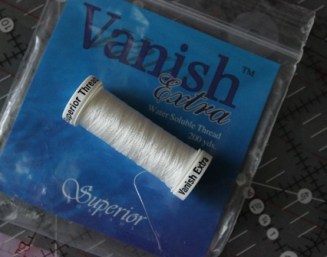
First, you need water soluble thread.

vanish thread extra

Superior’s Vanish Extra Water Soluble Thread

Second, you use the water soluble thread on top and a matching cotton thread in the bobbin.

Third, layer two pieces of batting under one piece of fabric and stitch where you want the trapunto using your sewing machine.

Fourth, cut away the batting along the edge of the stitching with applique scissors.

Fifth, add batting and backing as you normally would.

Sixth, quilt along the water soluble stitching.

Seventh, bind it and wash it.

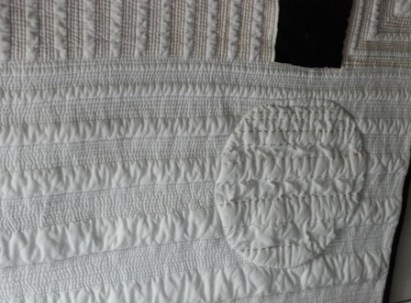
trapunto back of quilt top

The white sections are where the layers of batting have been cut away, leaving the two layers of batting; they stay put with the water soluble thread and cotton bobbin thread. 

I applied these skills to my Solitude quilt top. The bottom section of the quilt is trapunto. I made each batting section progressively larger to give it an horizon. I filled in with matchstick stitching.

As Lynn explains in the video, it is easy to snip the top when cutting away the batting. I used applique scissors but they were too sharp on the end, and I cut my quilt top multiple times. If I do this again, I will try a different pair of applique scissors.

Solitude! detail view

I did not trapunto the whole quilt. I experimented with matchstick quilting to get a similar effect. That is the quilting on the top left. I used my walking foot and stitched lines every half inch then filled in with the matchsticks, every other one.

After it was quilted, I realized my “black pencil” looked like an exclamation point, so I added the a trapunto “point” to it. It’s appliqued by hand to the finished quilt. I hand quilted the trapunto sections. It gives it more Volume, and I hope something different to the quilt.

This chapter made me whine the most. I thought I understood Volume and I didn’t need to make an entire quilt using this technique. I was wrong. In Solitude!, I found a design tool I will apply to future projects.

The next and last chapter is Texture. Carolyn’s project is called, “Crazy.” I do like the idea of being inspired by Crazy quilts and their decorative embroidery stitches.

Stay tuned,

Wanda 

Let’s talk Emphasis

The fifth chapter in Carolyn Friedlander’s book, Savor Each Stitch, is EMPHASIS.  She says, “Emphasis is all about making a thoughtful decision about how to bring your design to life. Through fabric placement, quilting intention, and all of the other tools explored in this book, you can create emphasis by highlighting different parts of a design.”

I’m a part of a Savor Each Stitch Book Bee, and we’ve studied line, contrast, scale and color.

Emphasis seemed like an easy concept. For example, Susan posted this wonderful diagram worksheet from a site by Claudia Jacques and emphasis stands out as merely focusing one’s attention on a particular item. That “red” person stands out, right? From this worksheet, line and color are the tools, and contrast, emphasis and scale are ways to take those tools and make art. Elements_Principles_Overview[1]

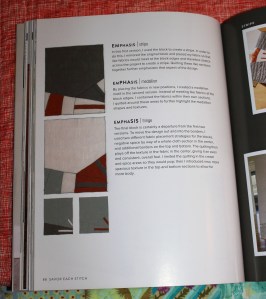
The project from Carolyn’s book involved a block with 10 pieces, and by changing the color or emphasis of each piece she changed which part of the block stood out:

emphasis chapter

I wanted something less paper-piecing intensive. I had observed a quilting friend’s traditional block sampler and mused about how the Drunkard’s Path stood out and I liked it a lot. Two pieces — I could do that.

With my new acrylic template in hand, I started making quarter circles and experimented with changing the emphasis in this traditional block to make something unique.

I love it. It’s very me.

emphasis top

The size is 57″ by 71″. Each block was 4″ unfinished and each Drunkard’s Path was 14.5″ unfinished. You will notice I turned some of the quarter circles to make a few half circles and one three-quarter circle. I also used a grey geometric print as the background and in some places I didn’t make any quarter circles. There are four rows by five rows of Drunkard’s Paths.

Now that the top is pieced, it doesn’t scream “emphasis”, but that is where it began. I’m thinking of naming it “Mod Drunk.”

I will have to decide how to quilt it and that will be another way to explore the concept of EMPHASIS.